

Article: Les imperfections persistantes de l'adulte nécessitent de l'équilibre, pas de l'agression

Les imperfections persistantes de l'adulte nécessitent de l'équilibre, pas de l'agression
Les imperfections adultes persistantes ne sont pas toujours le signe que la peau a besoin d'être davantage nettoyée, exfoliée plus intensément ou débarrassée de toute trace d'huile.
Souvent, elles reflètent un déséquilibre plus complexe impliquant un excès de sébum, un renouvellement cellulaire irrégulier au sein du follicule, des micro-organismes, une inflammation et une barrière protectrice qui peut déjà être vulnérable.
Cette distinction est importante. La peau adulte peut présenter des imperfections récurrentes tout en étant déshydratée, sensible ou inconfortable. Corriger une préoccupation au détriment des autres peut créer une routine qui semble active mais rend la peau moins résiliente.
Le Sérum Vivant de Biologique Recherche a été développé pour cette contradiction exacte : une peau adulte qui a besoin d'aide pour lutter contre les imperfections persistantes sans être soumise à une autre formule agressive et desséchante.
Que sont les imperfections adultes persistantes ?
Les imperfections adultes désignent généralement les imperfections qui persistent, réapparaissent ou commencent après l'âge de 25 ans environ. Elles peuvent se manifester différemment de la congestion majoritairement comédonienne souvent associée à l'adolescence.
Sur la peau adulte, les imperfections sont fréquemment accompagnées de rougeurs visibles, de sensibilité, de marques post-imperfections et d'épisodes qui reviennent dans des zones familières. Les fluctuations hormonales, le stress, le mode de vie, les pratiques de soins de la peau et la biologie individuelle peuvent tous influencer comment et quand elles apparaissent.
Le point important est que les imperfections persistantes sont rarement expliquées par une cause isolée. Elles impliquent l'environnement à l'intérieur et autour de l'unité pilosébacée – le follicule et sa glande sébacée associée.
Pourquoi les peaux adultes sujettes aux imperfections nécessitent une approche différente
Quatre mécanismes interconnectés contribuent couramment aux imperfections visibles :
-
Excès de sébum : Les glandes sébacées libèrent plus d'huile que la peau n'en a actuellement besoin.
-
Kératinisation irrégulière : Les cellules qui tapissent le follicule s'accumulent et contribuent à la congestion.
-
Déséquilibre microbien : L'environnement au sein du follicule peut favoriser les micro-organismes et les comportements microbiens associés à l'inflammation.
-
Inflammation : Le follicule et la peau environnante deviennent visiblement rouges, gonflés ou inconfortables.
La peau adulte peut subir ces mécanismes en même temps qu'une sensibilité accrue, une déshydratation et une fragilité de la barrière cutanée. Des recherches mesurant les paramètres de la barrière cutanée ont trouvé des différences significatives entre la peau sujette aux imperfections et les témoins non affectés, y compris des changements dans la perte d'eau transépidermique — le mouvement passif de l'eau à travers l'épiderme.
C'est pourquoi la réduction de l'huile seule n'est pas toujours suffisante. Une routine réussie doit cibler les imperfections visibles tout en respectant l'hydratation, l'intégrité de la barrière cutanée et le confort de la peau.
Le microbiome cutané est un écosystème, pas un ennemi
Le microbiome cutané est la communauté de micro-organismes qui vivent sur la peau. Le terme microbiote fait référence aux micro-organismes eux-mêmes ; microbiome décrit ces organismes avec leur matériel génétique et leur environnement.
Certains de ces micro-organismes sont impliqués dans le fonctionnement normal de la peau. Cutibacterium acnes, par exemple, ne se trouve pas seulement sur les peaux à imperfections. C'est également un habitant commun des peaux sébacées saines.
La question est donc plus nuancée que : « Comment éliminer les bactéries ? » La recherche examine de plus en plus les différences entre les souches microbiennes, l'équilibre, le comportement des biofilms et l'environnement qui permet à certains micro-organismes de devenir plus inflammatoires.
C'est important car tenter d'éliminer indistinctement la population microbienne de la peau n'est pas la même chose que d'aider l'écosystème à retrouver sa stabilité.
Pourquoi l'assèchement excessif peut rendre la situation plus difficile
L'huile et l'eau sont des composants différents de la physiologie cutanée. Un teint peut produire un excès de sébum et être quand même déshydraté.
Lorsqu'une routine agressive élimine à plusieurs reprises les lipides de surface ou crée une irritation, la peau peut se sentir tendue et temporairement mate, tandis que sa barrière devient moins confortable. Une perte d'eau transépidermique accrue peut contribuer à la sécheresse, aux picotements et à la sensibilité – les conditions exactes qui rendent une routine corrective plus difficile à tolérer de manière constante.
Chez Loshen & Crem, nous ne croyons pas qu'une peau plus nette doive se faire au détriment de la barrière cutanée.
L'objectif n'est pas de rendre le teint aussi sec que possible. Il s'agit de créer un environnement dans lequel l'excès de brillance, les imperfections persistantes, les rougeurs et la santé de la barrière peuvent être considérés ensemble.
Prébiotiques et postbiotiques : quelle est la différence ?
Prébiotique et postbiotique sont des termes liés, mais ils ne signifient pas la même chose.
Les prébiotiques sont des substrats qui aident à nourrir certains micro-organismes bénéfiques. Dans une formule topique, ils sont utilisés pour soutenir un environnement dans lequel le microbiote cutané peut maintenir un meilleur équilibre.
Les postbiotiques sont des composés non vivants ou des métabolites produits par fermentation microbienne. Ils peuvent fournir des matériaux bioactifs sans introduire de micro-organismes vivants dans la formule.
Cette relation complémentaire est au cœur du Sérum Vivant : le prébiotique aide à soutenir l'écosystème cutané, tandis que le postbiotique fournit des composés bioactifs immédiatement disponibles.
Découvrez le Sérum Vivant de Biologique Recherche
Né de l'héritage culte du Masque Vivant, le Sérum Vivant de Biologique Recherche est le premier sérum visage de la marque créé spécifiquement pour les imperfections adultes persistantes.
C'est une formule quotidienne multi-correctrice conçue pour :
- Réduire visiblement les imperfections persistantes
- Réduire les rougeurs associées aux imperfections
- Réguler l'excès de sébum et la brillance visible
- Affiner la texture inégale de la peau
- Soutenir le microbiome cutané
- Réduire la perte d'eau transépidermique
- Préserver le confort de la barrière cutanée
Plutôt que d'aborder chaque imperfection comme quelque chose à assécher, le Sérum Vivant agit progressivement pour aider les peaux sujettes aux imperfections à retrouver une apparence plus nette, plus calme et plus équilibrée.
Comment fonctionne le Sérum Vivant ?
Le Sérum Vivant associe trois actifs complémentaires issus de la biotechnologie.
Extrait de levure : le postbiotique signature Vivant
Dérivé de la fermentation de Saccharomyces cerevisiae, l'extrait de levure est naturellement riche en acides aminés et en métabolites bioactifs. Il aide à soutenir les peaux sujettes aux imperfections et à cibler les marqueurs biologiques associés aux rougeurs liées aux imperfections.
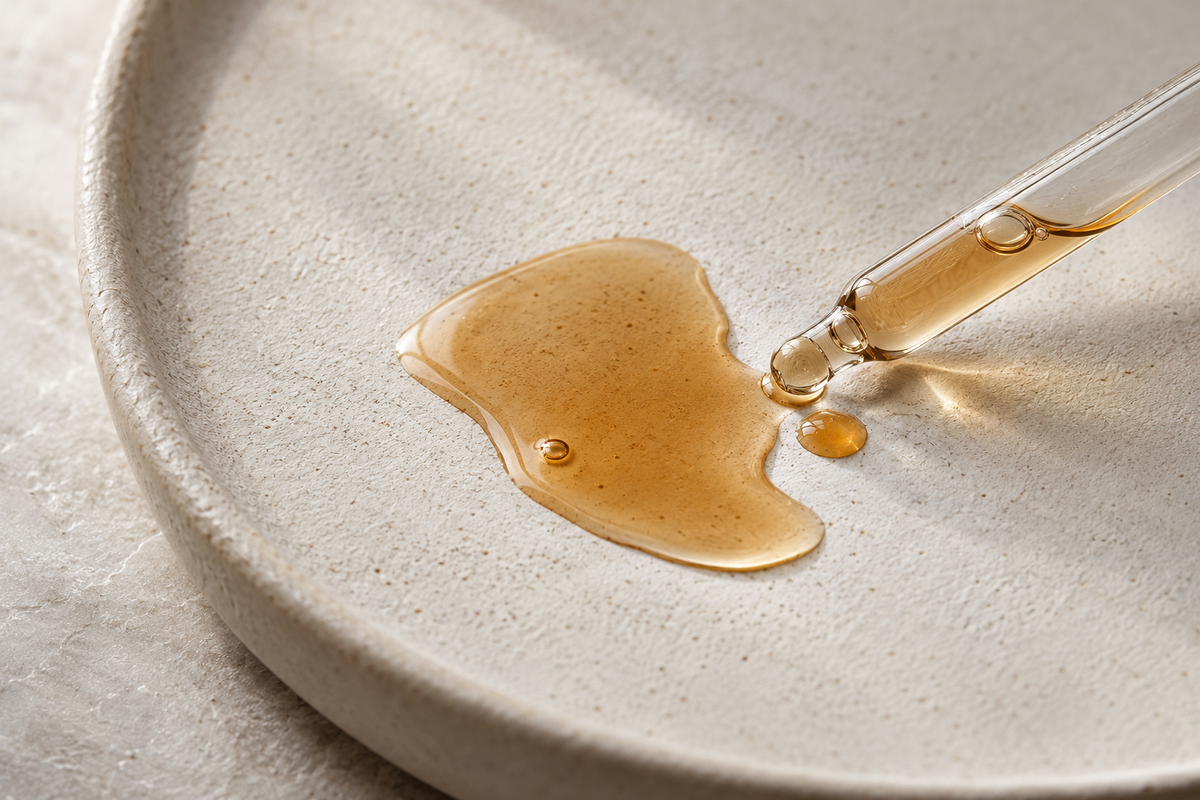
Les ingrédients dérivés de la levure sont également responsables de la couleur ambre-brun caractéristique du sérum et de son parfum naturellement distinctif.
Inuline : support prébiotique pour l'écosystème cutané
L'inuline est un polysaccharide prébiotique. Elle aide à nourrir sélectivement les micro-organismes bénéfiques naturellement présents à la surface de la peau, favorisant la diversité microbienne, la fonction barrière et le confort.
Polylysine : un actif biomimétique dérivé de la fermentation
La polylysine est un biopolymère dendritique composé de plusieurs unités de lysine. Sa structure permet une interaction sélective avec les micro-organismes associés aux imperfections, y compris Cutibacterium acnes.
Ensemble, ces ingrédients créent une approche prébiotique-postbiotique destinée à soutenir l'écosystème cutané tout en traitant visiblement les imperfections tenaces.
Qu'ont révélé les évaluations cliniques ?
Avec une utilisation biquotidienne, Biologique Recherche a rapporté des améliorations progressives visibles et instrumentales :
- 27 % de réduction de l'excès de sébum après 14 jours
- 19 % d'amélioration de l'apparence de la texture affinée après 14 jours
- 42 % de réduction des imperfections persistantes après 28 jours
- 21 % de réduction de l'intensité des rougeurs après 28 jours
- 19 % de réduction de la perte d'eau transépidermique après 28 jours
La formule a été évaluée sous contrôle dermatologique sur des hommes et des femmes, y compris des participants ayant une peau sensible.
Ces résultats proviennent d'évaluations instrumentales et cliniques distinctes impliquant 19 à 21 participants. Les résultats individuels varieront, et un sérum cosmétique ne remplace pas les soins médicaux lorsqu'une affection cutanée nécessite un diagnostic ou un traitement.
Quelle sensation procure le Sérum Vivant ?
Le Sérum Vivant est un sérum aqueux légèrement visqueux et gélifié. Il procure une glisse douce et soyeuse et offre un fini doux et non gras, sans sensation de lourdeur ou d'occlusion.
La formule est traitée à froid pour aider à préserver l'intégrité et la qualité de ses ingrédients actifs. Sa couleur et son parfum font partie de la signature sensorielle reconnaissable de Vivant et reflètent la présence de ses actifs dérivés de levure plutôt qu'une tentative de rendre la formule esthétiquement conventionnelle.
Nous aimons cette honnêteté.
À qui le Sérum Vivant convient-il le mieux ?
Le Sérum Vivant est particulièrement adapté aux :
- Adultes présentant des imperfections persistantes ou récurrentes
- Peaux mixtes ou grasses avec des rougeurs visibles
- Peaux présentant un excès de brillance, une texture irrégulière ou des pores d'apparence dilatée
- Peaux sujettes aux imperfections qui sont également sensibles ou déshydratées
- Peaux qui ne tolèrent plus les routines purifiantes agressives
- Toute personne recherchant un complément quotidien au Masque Vivant
Ce n'est pas automatiquement le sérum correct pour chaque personne présentant une imperfection. Les protocoles Biologique Recherche sont sélectionnés en fonction de l'Instant de Peau® actuel plutôt que d'une étiquette de type de peau permanente.
Sérum Vivant, Complexe Iribiol ou Dermopore ?
Ces trois sérums Biologique Recherche ne sont pas interchangeables.
| Sérum | Focus principal | Idéalement adapté à | Rôle distinctif |
|---|---|---|---|
| Complexe Iribiol | Imperfections actives et peau grasse | Peau hyper-séborrhéique ou imperfections localisées | Purifie et aide à réduire les imperfections visibles et l'excès de sébum ; fréquemment utilisé de manière plus localisée |
| Dermopore | Pores d'apparence dilatée et brillance de la zone T | Peau mixte ou grasse présentant des pores visibles | Affine l'apparence des pores et matifie les zones d'excès de brillance |
| Sérum Vivant | Imperfections adultes persistantes, rougeurs, sébum et texture | Peau adulte sujette aux imperfections, y compris les peaux sensibles | Offre un soin multi-correcteur tout en soutenant le microbiome, la barrière cutanée et le confort |
L'option la plus adaptée dépend de ce que la peau exprime actuellement. Dans certains protocoles, plus d'un sérum peut être utilisé dans différentes zones ou à différentes étapes.
Comment intégrer le Sérum Vivant à une routine Biologique Recherche
Appliquez le Sérum Vivant matin et soir après la Phase d'Initialisation et avant votre crème hydratante.
Une routine complète pourrait ressembler à ceci :
- Nettoyez avec le lait sélectionné pour votre Instant de Peau®.
- Appliquez la Lotion P50 appropriée.
- Utilisez le Masque Vivant à la fréquence recommandée par votre expert en soins de la peau.
- Appliquez quelques gouttes de Sérum Vivant sur le visage, le cou et le décolleté, en évitant le contour des yeux.
- Appliquez tout Sérum Authentique supplémentaire prescrit.
- Appliquez la crème de traitement sélectionnée pour votre peau.
- Terminez par un écran solaire à large spectre chaque matin.
Lorsque plusieurs Sérums Authentiques sont combinés, le Sérum Vivant est appliqué immédiatement avant Colostrum VG et/ou Sérum Spectral.
La constance est plus importante que l'intensité. Les évaluations soutenant le Sérum Vivant ont utilisé une application biquotidienne pendant jusqu'à 28 jours.
La perspective de Loshen & Crem
Les imperfections persistantes peuvent être frustrantes justement parce qu'elles réapparaissent. Cette frustration peut inciter à ajouter un autre acide, à nettoyer de nouveau ou à rechercher la sensation d'une peau parfaitement sans huile.
Mais la santé de la peau ne se construit pas par la punition.
La question la plus utile n'est pas simplement : « Comment faire disparaître cette imperfection ? » C'est plutôt : « Que se passe-t-il dans cet environnement cutané, et de quoi a-t-il besoin pour fonctionner plus efficacement ? »
C'est ce qui rend le Sérum Vivant intéressant pour nous. Il reconnaît que les peaux adultes sujettes aux imperfections peuvent avoir besoin de correction et de douceur en même temps.
Il travaille avec la peau, pas contre elle.
Foire aux questions sur le Sérum Vivant
Le Sérum Vivant est-il identique au Masque Vivant ?
Non. Le Masque Vivant est un traitement intensif à rincer utilisé périodiquement. Le Sérum Vivant est un sérum visage sans rinçage conçu pour un usage quotidien matin et soir. Les deux produits peuvent être intégrés dans le même protocole personnalisé.
Les peaux sensibles peuvent-elles utiliser le Sérum Vivant ?
Oui. Biologique Recherche identifie le Sérum Vivant comme adapté aux peaux sensibles, et l'évaluation clinique a inclus des participants ayant une sensibilité. La routine complète doit toujours être adaptée avec soin, en particulier lorsque la Lotion P50 ou d'autres produits correcteurs sont utilisés.
Le Sérum Vivant assèche-t-il la peau ?
Le Sérum Vivant a été créé pour réduire l'excès de sébum sans recourir à un assèchement agressif. Les mesures cliniques ont également montré une réduction de la perte d'eau transépidermique après 28 jours, ce qui confirme son positionnement respectueux de la barrière cutanée.
Le Sérum Vivant aide-t-il à réduire les pores visibles ?
Il peut aider la texture de la peau et les pores visibles à paraître plus affinés en régulant l'excès de sébum et en améliorant l'apparence de la texture irrégulière. Lorsque les pores dilatés sont la principale préoccupation sans imperfections persistantes ni rougeurs, Dermopore peut être l'option la plus spécifique.
Combien de temps faut-il pour que le Sérum Vivant agisse ?
Biologique Recherche a rapporté une réduction du sébum et une texture d'apparence plus affinée après 14 jours, suivie d'améliorations des imperfections persistantes, des rougeurs et de la perte d'eau après 28 jours d'utilisation biquotidienne.
Le Sérum Vivant peut-il être utilisé avec la Lotion P50 ?
Oui. Le Sérum Vivant est appliqué après la Lotion P50 sélectionnée pour l'Instant de Peau® actuel. La version et la fréquence appropriées de la Lotion P50 doivent être personnalisées en fonction de la sensibilité et de l'état de la barrière cutanée.
Le Sérum Vivant peut-il être utilisé avec ISO-Placenta ?
Oui, lorsque cela est recommandé. Le Sérum Vivant cible les imperfections persistantes, les rougeurs associées et l'excès de sébum. ISO-Placenta peut être ajouté pour soutenir les peaux présentant des marques post-imperfections.
Le Sérum Vivant est-il un traitement médical contre l'acné ?
Non. Le Sérum Vivant est un soin cosmétique développé pour les peaux sujettes aux imperfections. Une acné persistante, douloureuse ou aggravante doit être évaluée par un professionnel de la santé approprié.
Le Sérum Vivant contient-il des parfums ajoutés ?
Le parfum ou "Parfum" n'apparaît pas dans la liste officielle des ingrédients. La formule a un parfum naturellement distinctif associé à ses actifs dérivés de levure.
Un avenir plus clair pour les peaux sujettes aux imperfections
Le lancement du Sérum Vivant représente quelque chose de plus grand que l'arrivée d'un autre sérum anti-imperfections.
Il reflète une compréhension évolutive de la peau : la production de sébum, les micro-organismes, l'inflammation, l'hydratation et la fonction de barrière n'opèrent pas de manière isolée. Les protocoles les plus efficaces respectent ces relations.
Les imperfections adultes persistantes ont besoin de correction. Mais la correction ne doit pas nécessairement signifier l'agression.
Parfois, l'approche la plus avancée est aussi la plus respectueuse.
Découvrez le Sérum Vivant de Biologique Recherche
Pour des conseils personnalisés, contactez un expert en soins de la peau Loshen & Crem avant de créer ou de modifier votre protocole Biologique Recherche.
À propos de l'auteur
Sarah-Maude Cabana est la fondatrice de Loshen & Crem et une esthéticienne avec 20 ans d'expérience professionnelle. Son approche se concentre sur la santé de la peau, l'intégrité de la barrière cutanée, l'éducation et des protocoles réfléchis sélectionnés en fonction de la peau devant nous, et non des tendances, de la peur ou des étiquettes permanentes.
Laisser un commentaire
Ce site est protégé par hCaptcha, et la Politique de confidentialité et les Conditions de service de hCaptcha s’appliquent.